

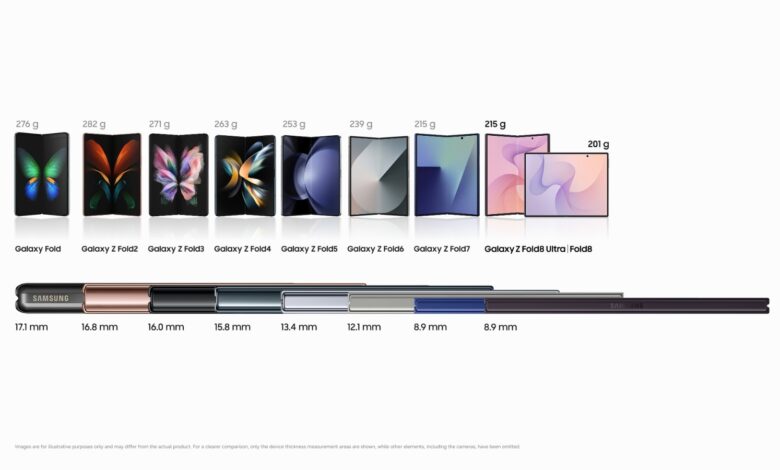
Since introducing the first Galaxy Fold at 276 grams in 2019, Samsung Electronics has continued to expand what a foldable smartphone can be, advancing hinge and display design, durability and usability with every generation.
As those technologies evolved, Samsung focused on another challenge: making a large-screen foldable easier to carry every day, without losing the experiences that make the form factor unique.
And through that pursuit, Galaxy Z Fold5 weighed 253 grams, and Galaxy Z Fold6 reduced its weight further to 239 grams.
With Galaxy Z Fold7 came an even more ambitious goal:
“Could a foldable be lighter than a bar-type flagship smartphone?”
At the time, Galaxy S25 Ultra — one of Samsung’s flagship bar-type smartphones — weighed 218 grams. So, the development team set an even lighter weight target for Galaxy Z Fold7: 215 grams.
Galaxy Z Fold7 reached that goal. And now, building on years of foldable innovation, Galaxy Z Fold8 combines a new form factor with advances in core technologies, materials and internal architecture to weigh just 201 grams — 52 grams lighter than Galaxy Z Fold5. At 201 grams, Galaxy Z Fold8 is the world’s lightest fold.
Galaxy Z Fold’s weight and thickness evolution by generation, from 276 grams and 17.1 millimeters with the first Galaxy Fold to Galaxy Z Fold8 at 201 grams and 9.7 millimeters, the world’s lightest foldable, alongside Galaxy Z Fold8 Ultra at 8.9 millimeters thick.
But consumers expected more than just a lighter foldable.
A 2024 YouGov survey found that a bulky or heavy design remained a concern among consumers not planning to purchase foldables, while battery life, durability and display quality ranked as top priorities for those considering them.
This insight shaped a core engineering goal for Samsung: make foldables thinner and lighter, while maintaining the core experiences users value most.
Battery life, camera performance, thermal management and durability still had to advance.
That could not be achieved by changing a single component. Samsung engineers had to reimagine the entire device — advancing fundamental foldable technologies, introducing new materials and revisiting hundreds of components and auxiliary parts to the fraction-of-a-gram level